(Blood on the Clocktower) Applying Game Theory to the Final Al-Hadikhia Night with 3 Players Alive
Posted: 2026-05-18
Note: This post will not make sense if you are not familiar with the game Blood on the Clocktower. Check it out at https://bloodontheclocktower.com!
Situation: Al-Hadikhia and 2 good players proceed into the night as the only remaining alive players. The good team has solved the game and knows who the Demon and Minions are. Tonight, Al-Hadikhia will choose the 2 living good players A and B and one of their dead minions C; everyone knows this will happen. The Storyteller has asked for silence and players A, B and C have not and cannot coordinate their choices.1 2
Questions: What are the optimal strategies for players A, B and C? What are the probabilities of each team winning?
Answer: The good team wants to have another day in which they will nominate and execute the Demon. This means that 2 of players A, B and C must make it out alive for the good team to win. The optimal strategy for each player is the same - chose to die with a probability of 1/3 (ie. choosing to live twice as likely as choosing to die). The evil team is slightly favoured with a chance to win of 5/9 or ~56%.
Proof: We can model this with game theory, which the design of Al-Hadikhia embodies well. The utility matrices are below. Ad means player A chose to die, Al to live, and same for B and C. Outcomes are listed for players A, B and C respectively - -1 means loss, +1 means victory.
If C chooses to die:
Cd |
Bd |
Bl |
|---|---|---|
Ad |
-1,-1,+1 |
-1,-1,+1 |
Al |
-1,-1,+1 |
+1,+1,-1 |
If C chooses to live:
Cl |
Bd |
Bl |
|---|---|---|
Ad |
-1,-1,+1 |
+1,+1,-1 |
Al |
+1,+1,-1 |
-1,-1,+1 |
The first 2 numbers are always equal and represent whether the good team will win. Eg. if A and B and C all choose to die (top left cell in the upper matrix), A and B lose and C wins (denoted by -1,-1,+1).
We are looking for optimal mixed strategies. Each player will make their choice randomly with some probability for each option. Let P(Ad) be the probability at which A chooses to die, and so on. Due to their symmetry, A and B will have the same optimal strategy3.
P(Ad) = x
P(Al) = 1-x
P(Bd) = y   = x
P(Bl) = 1-y = 1-x
P(Cd) = z
P(Cl) = 1-z
To find the optimal mixed strategy for a player, we need to find expected utility values for each choice and equalize them. This gives the player a strategy that is indifferent to other player’s strategies. That player will always have the same odds of winning. When each player uses their optimal mixed strategy, they are in a mixed strategy Nash equilibrium.
Let U(Cd) be the expected utility value of C choosing to die. We multiply C’s utility values from the upper matrix with probabilities of those cells ocurring, then sum up the products. Since we’re calculating U(Cd) that means we’re hard-fixing on C choosing to die for that particular calculation and pretend like P(Cd)=1.
U(Cd) = x*y*(+1)+x*(1-y)*(+1)+(1-x)*y*(+1)+(1-x)*(1-y)*(-1)
      = x^2+x*(1-x)+(1-x)*x-(1-x)^2
      = -2*x^2+4*x-1
We then calculate U(Cl) in a similar way.
U(Cl) = 4*x^2-4*x+1Posing that U(Cd)=U(Cl), we get 3*x^2-4*x+1=0. This equation has two solutions: x=1 and x=1/3. The first solution makes no sense as it’s saying that A and B should always choose to die; this causes them to always lose. So, the second solution it is.
When we ask that U(Ad)=U(Al), we get 2*x+2*z-3*x*z=1. Now that we know x=1/3, we can see that z=1/3.
The probabilities of each player winning are:
P(Aw) = (1-x)*(1-y)*z+x*(1-y)*(1-z)+(1-x)*y*(1-z) = 4/9
P(Bw) = P(Aw)
P(Cw) = 1-P(Aw) = 5/9
This exact thing happened in a recent game.↩︎
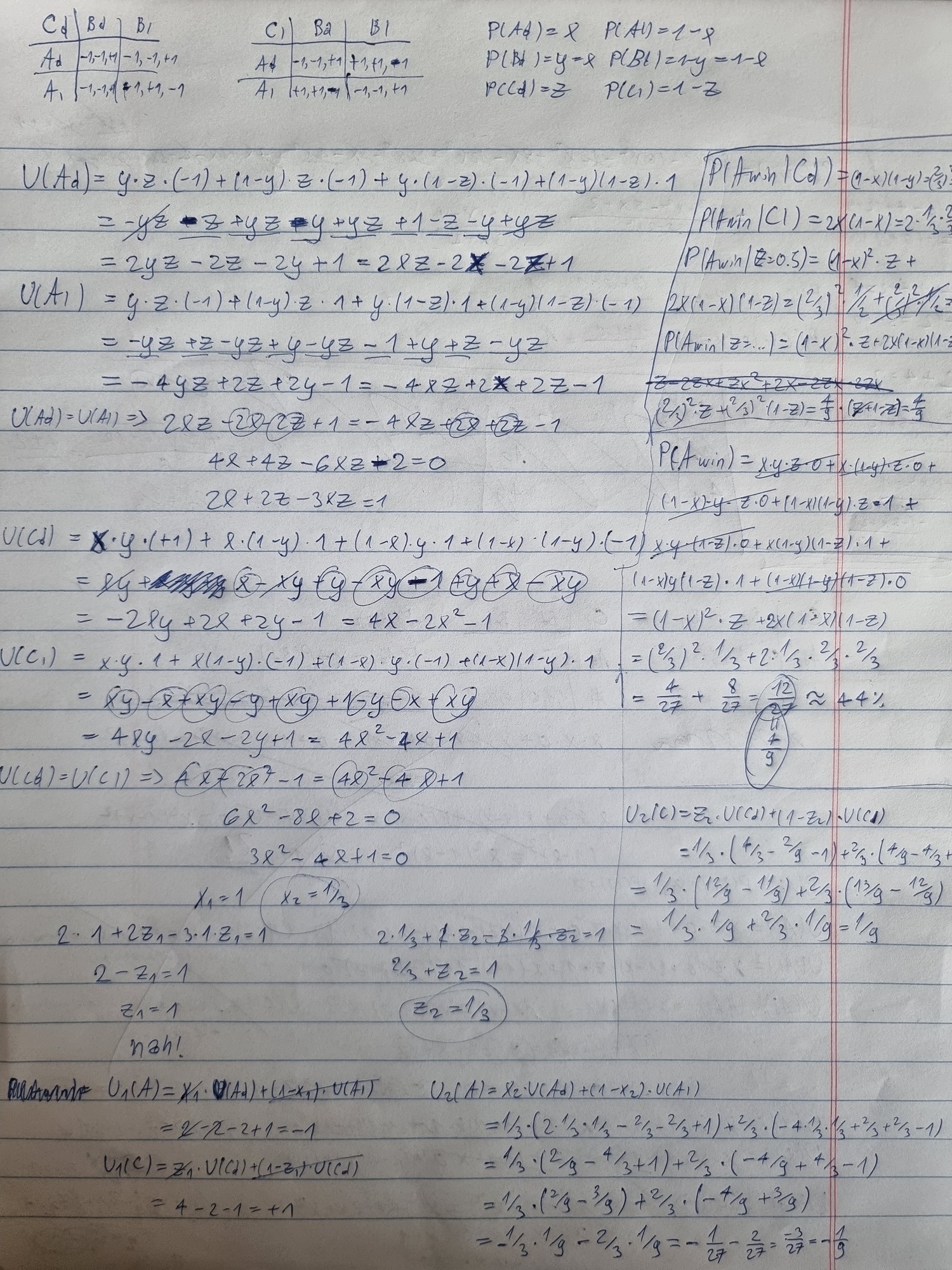
Here’s an image of my calculations to prove this wasn’t AI generated.↩︎
While, yes, A and B wake in a certain order, with no coordination they have no way to take advantage of that.↩︎